Showing posts with label Topps. Show all posts

Monday, December 22, 2014

Everything old is new again

I just came back with the mail today.  And in the mail was a card I won on eBay.

For 43 cents, a new Rod Carew is always a good thing.

But as I was placing him into my Carew binder, I started looking at all my Carew cards (not that there's enough of them. I have plenty of holes).

And I noticed something.


There's plenty of talk in the blogosphere about how Topps uses the same photo for card after card.  And rightly so.

But Topps has been doing this for years.  That's 2 1968s and a 1969.


Friday, June 6, 2014

Where have all the relievers gone?

I have not been posting much at all the last few weeks.  New position, new schedule, blah, blah.  I also really haven't had much to say lately.  Hopefully that's just a phase.

I decided I wanted to do a little research project for myself.  I don't know if anyone will be interested in the results or if they really say anything about Topps' choices for inclusion/exclusion.

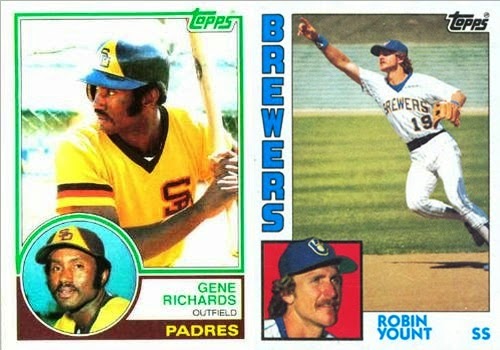
I have seen some posts here and there lamenting Topps checklist choices.  I myself had wondered whether relievers specifically were being represented.  So I decided to go back 30 years and compare 2013 Topps with 1983 Topps.


I had assumed that Topps was throwing in extra cards of the star players at the exclusion of role players and lesser known guys.  I wanted to find out if that 2nd or 3rd Mike Trout or Miguel Cabrera in the checklist was costing us a card of another player.

In 1983 the base set was 792 cards.  Of that 689 were distinct player cards - 87% of the set.  (What do I mean by distinct cards?  Just base player cards.  No Super Veteran, no Record Breaker, no League Leaders, no Checklist back, no Award Winners.  And one card per player, with career stats on the back.)  In 2013 the base set was 660 cards, 618 distinct players - 93.6%.  That kinda surprised me.  I had intended to include Update and make it 792 vs. 990, but a) 618 was more than I had expected, b) I think Update is where all the redundancy kicks in, and c) I got tired of cataloging cards.   So that's a point in 2013's favor.

On the other hand - 618 cards is only 20.6 cards per team.  689 cards in 1983 was 26.5 cards per team.  Definite point in 1983's favor.


There were 58 cards in the 1983 set that had multiple position designations, including 18 different designations - 1B/3B, 1B/OF, 2B/3B, 2B/SS, 2B/SS/3B, 3B/1B, 3B/2B, 3B/C, 3B/OF, 3B/SS, 3B/SS/2B, C/OF, DH/1B, DH/OF, OF/1B, OF/2B, SS/2B, and SS/3B.  Apparently in 2013 nobody plays multiple positions, as Topps listed only one position per player.  (When did Topps switch?)

(warning: lots of numbers to follow, proceed at your own risk.)


1B

 1983                                               2013
40                   cards                      36 
5.8%       pct of distinct cards        5.8%
1.5            cards per team              1.2

Not much of significance there. Topps seems to be treating first baseman roughly the same.


2B

 1983                                              2013
38                   cards                      38
5.5%       pct of distinct cards        6.2%
1.5            cards per team              1.3

Not much change here either.   Slightly more of the allocation.

3B

 1983                                              2013
49                   cards                      42
7.1%       pct of distinct cards        6.8%
1.9             cards per team             1.4

 Slightly less of the allocation here.  And less cards to begin with means 1/4 less third baseman overall.


SS

 1983                                              2013
46                   cards                      39
5.8%       pct of distinct cards        5.8%
1.5            cards per team              1.2

More of the same.  Am I wasting my time?  I guess I should point out here that I went with whatever position Topps listed.  And for multiple position designations in 1983, I used the first position.  Except pitchers.  I had to break them up myself.

OF

 1983                                              2013
146                   cards                      135
21.2%       pct of distinct cards        21.9%
5.6            cards per team             4.5

Similar to the first baseman.

C

 1983                                              2013
60                   cards                      44
8.7%       pct of distinct cards        7.1%
2.3            cards per team             1.5

 Okay, here's some change.  Topps is giving less love to the tools of ignorance.  1/3 less catchers per team in 2013 than in 1983.


DH

 1983                                              2013
19                    cards                        9
2.8%       pct of distinct cards        1.5%
1.4            cards per team             0.7

That's a pretty decent drop.  I wonder if Topps is really just assigning a fielding position to players more often than DH in 2013.  Or are there really less DHs roaming the American League?

SP

 1983                                              2013
139                   cards                      176
20.2%       pct of distinct cards        28.5%
5.4            cards per team             5.9

This is maybe the most significant change.  Starting pitchers are the only position that Topps is giving more cards to per team in 2013 than they did in 1983.  So that's a huge jump in allocation.

RP

 1983                                              2013
126                   cards                      99
18.3%       pct of distinct cards        16.0%
4.9            cards per team             3.3

Topps really is giving less love to relief pitchers in 2013, but its not as significant a drop as I had expected.  Although Topps clearly didn't get the memo about the usage patterns of relief pitchers.  Over the last 30 years starting pitchers probably haven't changed much since 5 man rotations were the norm then as now, but clearly more relief pitchers are used in today's game.  10-11 man staffs have given way to 12 or even 13 man staffs.  Those extra 2 pitchers are relievers.  So the drop is more drastic than it looks.  In 1983, there were 5 or 6 relievers on staff at a given time.  In 2013 its more like 7 or 8.

MGR

 1983                                              2013
26                   cards                      0
3.8%       pct of distinct cards         0.0%
1.0            cards per team            0.0

I think most will agree that this is one area that Topps drops the ball.  Who doesn't want managers in the base set?  I sure do.


So, what did we learn?

Not much probably.  We learned that I'm left-brained and I like numbers.  But that's beside the point.

Back in 1983 there were 26 teams.  With 30 teams now, there would need to be 795 cards to have the same number of cards per team.  I don't know if that feasible.  That's an 850 card base set.  We're back in Topps Total territory (I think.  Total was around when I was out of the hobby.)  But I do like the idea of 26 Angels better than 20 Angels.

Friday, March 21, 2014

Time Travel

I spent a couple of hours on Sunday attempting to get a handle on some unorganized cards stacked on the desk, stuck in boxes, stacked on boxes... you get the idea.  I sort my cards by brand.  I'm not sure if this what naybody else does, but it seems to work for me.  I still have about 1,000 Topps cards to get sorted but all the other brands got put either into their respective sets, or into one of my many "doubles" boxes.  Well, except for a stack of oddballs.  I think that's where my system fails me.

In going through my cards I kinda noticed something...well.... I think something became clearer to me.  Let's take a trip back in time.

Okay, not that far.  Way too far actually.  But that is a good looking piece of cardboard, no?


Yeah, there.  Let's go back to the late 70's.  What do these cards all have in common?  They're all made by Topps.  And they're rather unimaginative.  Maybe even boring depending on your point of view.  Don't get me wrong, I like these sets, but still. 

Fast forward a few years.

What do these cards have in common?  Still both made by Topps.  But much better looking cards.  Better design.  Better color.  Better.  At least I think so.  So what happened?


Those happened. 

To be clear, there are definitely some misses here too.  But there are some hits, and more importantly, there's a little competition.  Topps couldn't rest on its laurels.  Had to work a little bit.  Had to compete.  Had to deliver a better product.

Let's fast forward a couple more years.

1988

More competition.  If I'm not mistaken Score was the first company to use those hermetically sealed packages for their "wax" packs.  I remember being frustrated by those things.  And they put a full color picture on the back.  And they used whiter card stock.  Score may not have the huge footprint in the hobby of some other brands, but they actually came up with a couple innovations that would become standard practice. 

1989

Upper Deck took the next step from Score and introduced "premium" cards.  Their hermetically sealed packages were foil.  Their cardstock was even better.  Photos were probably better too.


But of course, they had to go and beat the dead horse.  And the dead donkey next to it.  The few brands started putting out more and more sets, and under more names too.

And eventually we end up here.  Too much competition.  Too many brands.  Each putting out too many sets.  I wasn't collecting by the early to mid 90's.  And I'm glad.  Who can keep up with all of this? 

In the span of less than 20 years, we went from 1 company putting out 1 set, to 15 companies putting out 15 sets each (or so it seems).

Fast forward to 2013.

That is probably not all of the sets put out by Topps in 2013.  And it doesn't include any of the Update versions.  Or any of the 30 inserts that were included in each set.  Or the 30 parallel versions of each set.  So we've now got the worst of both ends of the spectrum.  1 company putting out 45 sets every year.

Back in the day I could binder my PCs 1 year to a row.   It really worked for my OCD.   That's actually the binder page as it sits today.  You know how many Tony Gwynn cards were produced in the three years shown above?  41.  That includes oddballs like Mother's Cookies and Fun food pins.  41 is an attainable number.  You know how many Mike Trout cards were produced in 2013 alone?  540.  540 is not an attainable number.

Here's my rant, you can skip ahead if you want.

Hey MLB, you've got it wrong.  Again.  Since the day the National Association was formed in 1871, you baseball owners have been trying your darnedest to screw up the game.  Cross ownership of teams, Artificial supression of salaries, refusing to employ a large chunk of the population, failing to realize that revenue sharing is the only way to save the game, stubbornly sticking to the reserve clause, ignoring the impending age of Free Agency, allowing the NL and AL to have a major rule difference for 40 years, electing wimpy commissioners, failing to have a commissioner at all, etc. etc. blah, blah.  I know baseball cards aren't necessarily on the same plane of importance as the governance of the game, but you're screwing this up too.  I don't know what you think Topps is holding over your head, but I guarantee you that they need you more than you need them.  Issue another license to a company like Panini!  And another if there's a qualified company out there.  Sooner rather than later.  And follow that up by limiting every company with a license to a reasonable amount of product every year.  Let's see some competition in the marketplace!  Why should Topps showcase your business in a way that is best for you, when there's no competition for that dollar??  They showcase it in a way that is best for them, because there's no competition to stop them.

end of rant.

Don't get me wrong, I'm not anti-Topps.  I was always a Topps guy back in the day (despite my devotion to 1982 Fleer).  I just think Topps has run amuck.  Anyway, I think if we look over our history as a hobby, there's a couple lessons back there. 

Baseball cards are supposed to be fun, right?

Friday, February 28, 2014

This Way to my Mailbox

It was a good week at the mailbox here in the land of junk wax.  I got a few bubble mailers, including two on Monday.  What a great way to start the week.  Baseball Cards!

The first mailer came from Mark over at This Way to the Clubhouse.  (I can almost guarantee I'm not the first blogger to use this post title).    I saw a couple cards on his blog and asked about them. 

He sent me the Slayer parallel (yup, that's what I'm calling them, it makes sense to me, click the link.  I'll wait) of Garret Richards' 2014 card.  These things look better in person.  I'll trade the slime parallels and mustard parallels for these any day. 

Mark also sent along the Super Veteran insert of Albert Pujols.  This is still the only insert I have any interest in this year.  And this one happens to be an Angel (1/2 Angel?), so that's a win.

That's all I was really expecting.  But Mark didn't stop there.  He sent along a big stack of my 2014 base set needs.  I won't bother scanning them because a) everybody has seen them recently and b) I'm still mad at Topps for their collation this year (real or perceived.  Doesn't matter).

But Mark didn't stop there.


I made a comment to him about Topps base cards from the time I was away from the hobby.  I've decided to put together an album with just Topps base set Angels from 1961 to the present.  These will go right in there.


As will these.  My cousin (not technically my cousin, but my aunt is his godmother, and I've literally known him since I was born.  So, close enough) went to high school with Matt Walbeck.  Sat behind him on the bench of the baseball team too.


And parallels, sort of.  The emerald green from last year.  And I almost think of Opening Day as a parallel of the base set.  I mean they're kinda redundant.  But its an Angel, so I'm all for it.

Thanks again Mark.


Wednesday, January 1, 2014

Card Numbering Take 3

Okay, I have one last post in my ongoing series of posts about Topps' numbering systems.  1978-1979 was the first I noticed, then 1983-1984.  Finally we come to 1989-1990. 

team card/manager

There are a few less exact matches

pitchers
more pitchers


Through 1991

middle of lineup guys
but there are plenty of near misses to make it apparent Topps was re-using a template of sorts.  Other close ones are 17/16, 42/43, 68/65, 129/130, 190/187, 216/215, 243/244, 270/272, 332/334, 362/363, 455/458, 576/575, 602/603, 632/635, 649/650, 679/675, 708/705, and 761/762 (1989 first in all pairs).  In fact, I think there more pairs overall in 1989-1990 than in the other years.

That's all the coincidences I've found so far.  I don't know why I find that interesting, but I do.

Friday, December 27, 2013

Card Numbering Again


1978-1979 wasn't the only set of years that Topps decided to repeat some of their numbering pattern.  1984 Topps has been blogged about many times as a rip off of 1983 Topps.  I, of course, am in the minority position of liking 1984 as much as, or maybe more than, 1983.  But apparently

they liked the

numbering in 1983

so much

that they used it

again in

1984.

 Sometimes it carried from 1982

and once it

even went through 1985


Team card/manager card.  Coincidence?


Yeah, I ran out of stuff to say.  Newbie blogger.  There are other instances where the numbers are almost exact as well, 105/100, 262/266, 341/342, 416/415, 500/499, 547/548, 599/600, 623/626, and 678/680 (1983 first in all pairs).